January 2025 wildfires: Devastating impact on telecommunications networks in California

The January 2025 wildfires plunged several regions, particularly California, into a major crisis, highlighting the vulnerability of telecommunications networks to natural disasters. Thousands of residents and businesses were cut off from communication, further complicating situations for both authorities and citizens.

In California, the fires destroyed more than 300 cell towers, especially in the Sonoma region. For several days, thousands of people were left without access to mobile and Internet services, disrupting not only businesses but also emergency response efforts. In some rural areas, 50% of relay stations remained inaccessible for over a week.

The economic impact was significant. An online business estimated a $2 million revenue loss due to the Internet service disruption, emphasizing the importance of ensuring infrastructure resilience to minimize economic disruptions.

Had more resilient infrastructures been in place, repair costs could have been significantly lower. In 2020, similar wildfires had already cost California around $1.5 billion in telecommunications infrastructure repairs. According to the International Telecommunication Union (ITU), investments in stronger networks could have reduced these costs by 30% to 40%, representing savings of $450 million to $600 million.

Integrating real-time monitoring technologies and mobile relay stations could speed up service restoration, as seen in some regions after past wildfires. The cost of a mobile relay station is approximately $250,000, but it allows for a rapid return of coverage, which is crucial in times of crisis.

Ultimately, while investing in infrastructure resilience may seem costly in the short term, it provides considerable long-term benefits, both economically and in terms of public safety.

The events of January 2024 highlight the urgent need to incorporate resilience into the very design of telecommunications networks.

Sources:

https://www.itu.int/en/mediacentre/backgrounders/Pages/emergency-telecommunications.aspx
https://www.cpuc.ca.gov/-/media/cpuc-website/divisions/news-and-outreach/reports/annual-reports/ar2024_web_012825.pdf https://documents1.worldbank.org/curated/en/099121724111526960/pdf/P1785971617dfc0361b79b10ed943988d67.pdf https://www.reuters.com/business/energy/southern-california-edison-seeks-recover-16-bln-wildfire-related-losses-2024-08-29/ https://www.reuters.com/technology/un-body-protect-vulnerable-submarine-cables-after-ruptures-2024-12-12/

MCM Integration Certified ECO-RESPONSIBLE

We are very proud of our ECORESPONSIBLE™ Certification, level 1. Commitment.

It demonstrates our values ​​and our desire to improve from a sustainable development perspective. ECORESPONSIBLE™ Certification has allowed us to understand all aspects of sustainable development, social, economic and environmental. Our perception is no longer limited to the environmental impact alone. We now interpret sustainable development in its entirety.

The benefits of certification

An asset on the market

Thanks to our ECORESPONSIBLE™ Certification, we have an additional advantage when entering the international market. Our Certification positions us as a cutting-edge organization and allows us to add value to our service offering. Eco-responsible practices are a factor increasingly considered by clients.

Concrete results

We identified areas for improvement that turned into concrete results, including:

  • Integration of a horizontal management model
  • Transparent remuneration
  • No longer using single-use plastic packaging
  • 100% offset of carbon emissions linked to the transport of materials
  • Encourage our employees to use public transportation

A united, mobilized team

Our entire team mobilized with conviction in this stage of preparation for change. Our ECORESPONSIBLE™ Certification proved to be a success because all members of our team, including members of senior management, adhered to it and contributed to it. The exercise had an undeniable mobilizing effect.

We are proud to be part of ÉCOLEADERS du Québec!

Learn more about certification : www.ecoresponsable.net

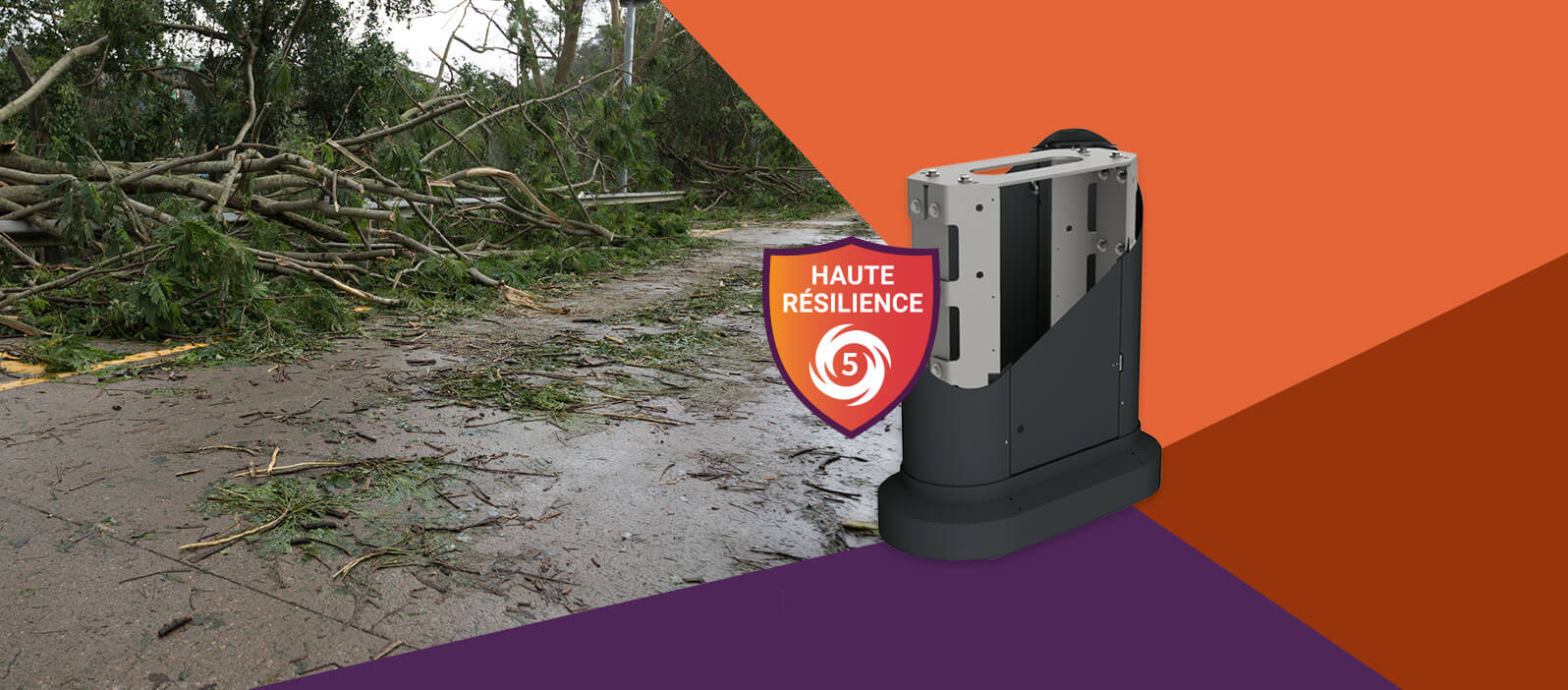
The Maestro XT+ cabinet by MCM, high resilience equipment

Since high-speed telecommunications connections have become essential today, ensuring better protection of these network infrastructures was necessary, which is now possible with the Maestro enclosure.

Standard boxes with bollards

Fibre optic network infrastructures include local distribution points called “optical nodes” in all the connected areas. The optical node, the entry point to each area, consists of an above-ground enclosure connected by an underground optical cable containing fibers for hundreds or thousands of customers. Bollards generally protect these above-ground enclosures.

Despite the protective bollards, above-ground enclosures remain vulnerable to impacts, particularly during an incident with a heavy vehicle (truck or snow loader) where contact with the cabinet is probable. The foreseeable consequence of such an impact is the movement of the cabinet on its base, which may result in the cutting of the leading optical cable, causing the interruption of service for customers connected to this optical node. Getting this strategic point back into operation can take considerable time and effort, especially during the cold season when incidents are more likely.

Furthermore, very violent winds can tear away objects and throw them all around during a hurricane, including onto above-ground cabinets containing critical equipment. We then find a situation comparable to an incident involving a heavy vehicle, with consequences like those described above. In all these circumstances, the quality of the anchoring of the above-ground enclosure becomes an important element.

A standard cabinet typically has four (4) anchors in the folded sheet metal forming the sides of the enclosure. Eight (8) large anchors are in the steel structure’s base in the Maestro cabinet, creating a solid and fixed cage in the lower part. This configuration prevents movement of the cabinet base as much as possible and, therefore, prevents accidental cutting of the leading optical cable.

The Maestro XT+ cabinet, a solution of choice

Maestro XT+

The Maestro XT+ cabinet, with its internal steel structure, is designed to protect critical components during major incidents, including climatic events. In the current context where high-speed telecommunications connections are essential, it becomes essential to strengthen the security of these network infrastructures.

Thus, although the Maestro cabinet can be used in several ways, for example, to make required energy/telecom connections for an event site, its exceptional solidity characteristics are particularly appreciated during incidents or extreme events, as seen more and more on the environmental level.

In the current context where high-speed telecommunications connections are essential, it becomes essential to strengthen the security of these network infrastructures. The Maestro XT+ cabinet, with its internal steel structure, is designed to protect critical components during major incidents, including climatic events.

The JDP, resistant to the worst weather

The Conventional Approach

Infrastructures for low-voltage energy distribution and wired telecommunications networks (optical fiber and cable television) exist in three ways:

  1. With overhead cables (on poles);
  2. With underground cables (with handholes and pedestals);
  3. In a hybrid version combining aerial and other underground.

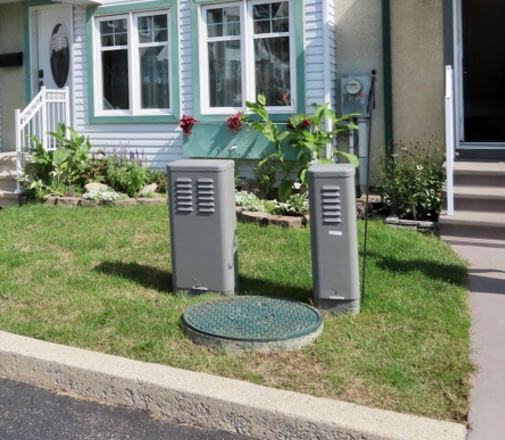
The 2nd option, the underground method, is generally considered the most reliable because it is less exposed to bad weather (wind, ice) and protected from conflicts with vegetation. However, we observe that, during major climatic events such as floods or hurricanes, all the above-ground connection equipment, including pedestals, remains vulnerable. Regular connection pedestals, made of thin sheet metal or plastic, are not designed to withstand even minor impacts, such as those observed during major climatic events.

Historically, repairing or rebuilding energy and telecom networks after a significant flood or hurricane can take several weeks or months. During this time, we must clean and repair or reconstruct civil infrastructures and buildings, which require energy and operational telecoms. In these circumstances, generators and cell phones are more of a makeshift option. Access to existing high-capacity energy and telecom networks in the affected area will significantly accelerate cleaning and reconstruction.

The MCM JDP, a solution of choice

JDP

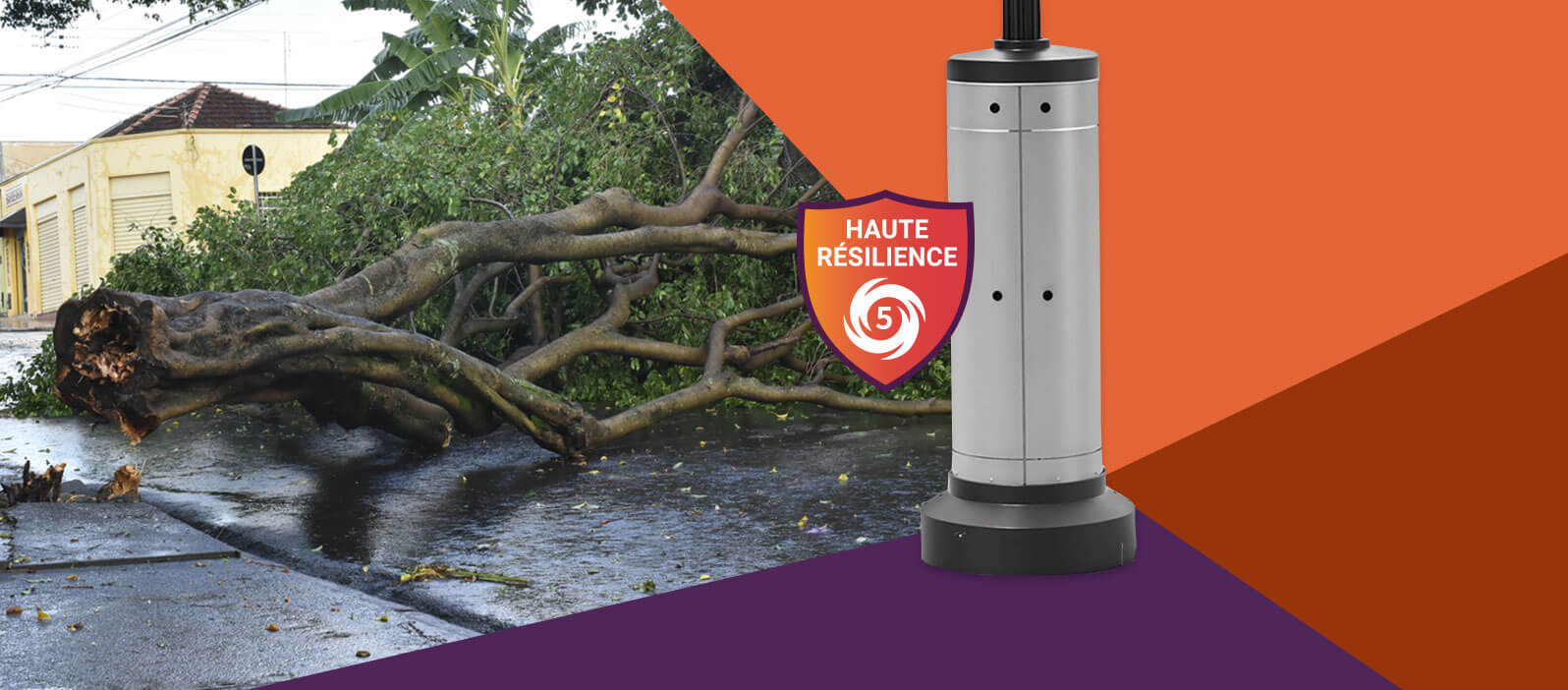
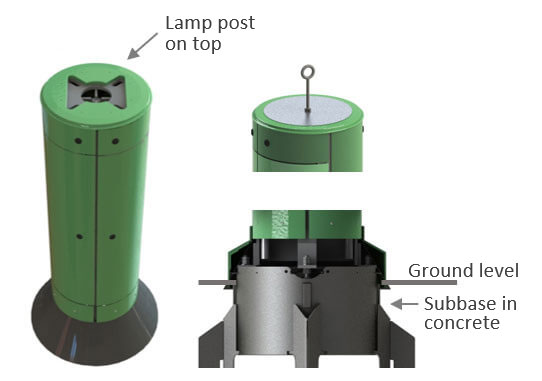
The JDP from MCM Integration can support a lamp post up to 10 m (30 ft.) high. With its robust steel structure (25 mm), the JDP cabinet weighs more than 180 kg (400 lb) and is solidly anchored on a 160 kg (350 lb) steel base buried in concrete. These characteristics make the JDP highly resistant to impacts, keeping it functional despite significant impacts. During an intense hurricane, the strong winds will likely remove the lamp post from the roof of the JDP, but this does not affect the functionality of the JDP.

Finally, rapid access to high-capacity energy and wired telecom networks after an intense climatic event will help speed up the cleaning and reconstruction of the disaster area. This characteristic is a significant advantage of the JDP concept, which also better integrates energy and telecom network connections into the urban environment.

The MCM’s JDP is a unique above-ground network infrastructure capable of withstanding the worst weather conditions while remaining functional.

Three main reasons why conventional pedestals are not compatible with urban densification.

Previously:

Individual homes previously benefited from large front lawns, allowing easy dissimulation of service pedestals in corners behind some bush. However, with the urban densification taking place, this situation has significantly changed.

Today:

The reduction of the size of lots, combined with an increased number of parking spots on every property, has transformed frontages by reducing the front lawns to such modest dimensions that it has become impossible to install and dissimulate pedestals easily. Furthermore, there is no more savings in building separate network infrastructures, given the actual costs for civil works, for concrete, and for the required legal servitudes.

The three main reasons:

  1. Lost of value

    In new residential developments, properties showing conventional pedestals on their small frontage are the last ones chosen by the buyers. Therefore, the presence of pedestals on your frontage will lower the value of your property. And since access to this equipment must be maintained, it is not recommended to try to hide them behind bushes.

  2. Required legal servitudes

    In most jurisdictions, a private lot requires a legal servitude to install a pedestal or a handhole, which implies costs and delays for the home builder or the land developer. One way to avoid these costs is to install these devices in the public easement along the street. However, installing pedestals in the public easement is generally avoided or forbidden.

  3. Construction costs

    Lately, costs of civil works have become prohibitive. It is therefore important to minimize the amount of required civil works when designing power and telecom infrastructures. Integrating the various networks within a single trench and make all the connections for a customer from a single point has become more economical.

Historically, in urban areas, pedestals take the shape of enclosures of various sizes installed along the streets, generally on front lawns.

Why do we need pedestals?

Pedestals and handholes usually serve to make customer connections on power and telecom networks. Therefore, they are normally dedicated to one service utility, either energy or telecom, each with its standards.

What types of networks use pedestals?

Wired networks need enclosures to make connections, which is not the case for wireless networks that use antennas instead to transmit signals. Meanwhile, to this day, power networks have only been made using wires, but power connections can be made underground, which is not usually the case for telecom connections.

The solution:

  • Integrate the pedestals into the lampposts

The lampposts are an excellent example of a required urban functional structure typically installed in the public easement. They are commonly needed every 100 feet, on one side or either side along the streets. For the pedestals and handholes to be integrated into the lamppost base, it must be possible to connect all the required services for 4 to 8 homes nearby, which is precisely what MCM Joint Distribution Pedestal (JDP) is proposing.

Since 2005, thousands of MCM JDPs have been installed in Eastern Canada. They have proven to be an effective solution to integrate the power and telecom connections in the base of lampposts. This concept has also proven to be economically viable by firstly reducing the required civil works significantly, one trench only being required to pass the power and telecom cables from one lamppost to another. 

The following grid compares the conventional approach, using separate pedestals and handholes, with the integrated system, using the MCM JDP :

DESCRIPTIONCONVENTIONALINTEGRATED WITH JDP
LocationFront lawnsPublic easement
Legal servitudesRequiredNot required
(JDP has its subbase)
Civil worksOne trench per serviceAll in a single trench
(Normalization required)
Concrete base for :
– Lamppost
– Telecom 1
– Telecom 2

Required
Recommended
Recommended

Not required
Not required
Not required
Power connectionHandhole requiredIncluded
Access in wintertimeOften difficult in snowAlways easy
DurabilityVariableLifetime
MaintenanceMinimalMinimal
No of customers4 to 8 per location4 to 8 per location
AestheticsPoorGood
Valeur des maisonsDeratedIntact or improved
Construction costsAs a reference15 % less
Engineering costsAs a reference25 % more

To successfully integrate the connected devices, the engineering firm has to gather the needs from each utility involved to physically relocate the connection points at the lampposts locations while complying with the utility standards. Although this exercise might seem complicated at first, it rapidly becomes a standard design method in the following projects. In addition, MCM provides free technical support at all the project stages, from advice for the design to instructions for the contractor regarding the installation of the JDP.